
Project Description
Abstract:
Nanocarriers can be built using amphiphilic molecules which are known to self-assemble into lamellar and non-lamellar phases (e.g. cubic and hexagonal) in water. Of these, the bilayer structure of bicontinuous cubic phases naturally mimic the cell membrane, thus making lipidic cubic phase systems suitable models for the study on encapsulation of therapeutic biomolecules. Despite the notable developments of methodologies, the main challenge of today’s nanotechnology is probably to develop systems that allow real progress to attain better protection of the active ingredient and enhancing site-specific delivery. Glycolipids are amphiphiles that could fulfill these requirements by improving the physicochemical properties of the nanocarriers and facilitating cell specific targeting through carbohydrate–biomolecules interaction. Understanding the key factors that tune/stabilize the cubic bilayer curvature are useful to formulate specific self-assembly materials for smart application in biotechnology.
Implementation Period:
08/2025 – 11/2025
Project:
- Project Objectives and Impact
The objectives of the project are to identify the structural effects exerted on the glucoside bicontinuous cubic phase (bulk systems) upon the addition of monoolein and cholesterol. Subsequently, the bulk systems are dispersed into nanoparticles and the effect of lipid compositions on the size characteristics and colloidal stability of model drug-free and model drug-loaded nanoparticles are investigated. The investigation on the molecular architecture of lipidic system is important and serves as a basis for better understanding the effects of lipidic composition on the lyotropic cubic phase forming lipid and its curvature tunability useful for designer delivery system.
- Results and Contributions
During the incoming research visit in September 2025, Dr. Noor Idayu Mat Zahid and Dr. Nurul Fadhilah Kamalul Aripin worked in the Soft Matter Application Lab (SOMAPP Lab) at TU Graz, a core facility supported by the Austrian Federal Ministry of Education, Science and Research, TU Graz, the University of Graz and Anton Paar GmbH, under the supervision of Dr. Manfred Kriechbaum. As a result of our collaborative work at TU Graz and at Universiti Malaya, we continued to study the liquid crystalline phase characterization using small-angle X-ray scattering (SAXS). In this project, a branched-chain glucoside with a 2-hexyl-1-decyl tail was synthesized and incorporated into monoolein-based (lipid) systems, both with and without cholesterol to evaluate its effect on the formation and stability of bicontinuous cubic phases in bulk. Phase behavior and structural transitions were systematically characterized as a function of composition and temperature. Selected formulations exhibiting stable non-lamellar phases were dispersed in phosphate-buffered saline (PBS) using Pluronic F-127 as a steric stabilizer and subjected to probe sonication to form nanoparticles. Drug-free and Thymoquinone-loaded cubosomes were then characterized in terms of internal nanostructure via small-angle X-ray scattering, SAXS.
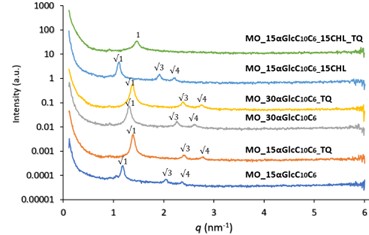
Figure 1. Scattering (SAXS) patterns for 2-hexyl-1-decyl β-D-glucoside incorporated into monoolein(MO)-based systems, both with and without cholesterol (CHL) at 25°C.
Drug-free and Thymoquinone(TQ)-loaded scattering patterns are also included. Peak positions at square root ratios of 1/3/4 indicate a hexagonal lattice of the nanostructure,
the pattern on top revealsa lamellar structure. Numbers 15 and 30 refer to the concentrations (© M. Kriechbaum and N.I.M Zahid).
The SAXS-curves reveal scattering peaks of hexagonal phase as shown in Figure 1 instead of cubic phase implying an increase in the negative curvature from the resulting self-assembly of the Pluronic triblock copolymer and the glycolipid due to increase in apparent hydrophobic volume of the lipids.
The study enables us to identify the composition and conditions that give highly stable nanoparticles with large water channel sizes to encapsulate a significant amount of Thymoquinone for an efficient nanodelivery system (“drug-carrier”). It also offers better networking / knowledge transfer in the SAXS method for nanostructure characterization to a wider range of students, faculty, and researchers. The results obtained from this project will be published in relevant peer-reviewed scientific journals.
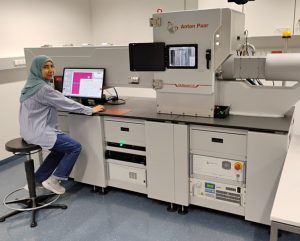
September 2025: Dr. Noor Idayu Mat Zahid from Universiti Malaya doing SAXS-measurement of glycolipid samples with the brand-new SAXSpoint 700 instrument
(Anton Paar) in the SOMAPP-laboratory of TU Graz at the Institute of Inorganic Chemistry (© Manfred Kriechbaum).
Project Team:
Dr. Manfred Kriechbaum (Project lead, Austria)
Graz University of Technology (TU-Graz), Austria
Institute of Inorganic Chemistry
Assoc. Prof. Dr. Noor Idayu Mat Zahid (Project lead, Malaysia)
Universiti Malaya (UM), Malaysia
Dr. Nurul Fadhilah Kamalul Aripin
Universiti Teknologi Mara (UiTM), Malaysia
Project Details
- Date April 7, 2026
- Tags Chemical Engineering, Chemistry
Comments are closed.